At-Home SubQ Fluids: How to Choose the Best Hypodermic Needle Size for Your Cat or Dog
Choosing the right hypodermic needle for at-home subcutaneous fluid therapy can make all the difference in your pet's comfort and treatment success. Whether administering fluids to a dehydrated cat or supporting chronic kidney disease management in your dog, needle gauge and length directly affect flow rate, tissue trauma, and overall safety. Veterinary professionals and pet caregivers alike must understand that incorrect sizing leads to unnecessary discomfort, failed injections, or even infection risks. This guide addresses both practical home-use considerations and the procurement standards that veterinary distributors, clinic managers, and medical device buyers need when sourcing reliable subcutaneous needles from certified manufacturers.
Understanding Hypodermic Needles for At-Home SubQ Fluid Therapy
Knowing how hypodermic needles work helps you make smart choices for both clinical uses and buying in bulk. Each clean needle has four important parts that work together to make fluid delivery safe.
Key Components of Medical-Grade Needles
The hub is usually made of medical-grade polypropylene (PP), and it safely links to syringes using standard Luer connections, which can be either Luer Slip or Luer Lock. This means that it can be easily integrated with fluid delivery methods in all veterinary offices. The shaft, which is made of high-quality stainless steel (AISI 304 or 316L), keeps its shape while penetrating tissue and doesn't rust when medication comes in contact with it. At the tip of the needle, the bevel, which is cut to exact angles, controls how hard the needle punctures and how much tissue moves. The lumen, or internal diameter, controls the flow rate of fluids. Thin-wall technology maximizes the inner diameter while keeping the outer gauge measurements the same, which makes it easier to deliver sticky medications.
Material Standards and Safety Features
AVACARE makes needles out of high-quality stainless steel that goes through strict processes for checking its tensile strength and finishing its surface. Our goods have a medical-grade silicone covering that is put on using controlled processes. This lowers the friction coefficients during insertion, which makes the patient less uncomfortable. The Sterility Assurance Level of 10^-6 is guaranteed by EO gas sterilization, which meets the standards for ISO 13485 and CE approval. Color-coded ISO hubs make it easy to find the right gauge quickly, which is very important in emergencies where accurate fluid resuscitation protocols are needed right away.
Disposable Versus Reusable Options in Veterinary Care
Cross-contamination risks with bloodborne germs are eliminated by single-use disposable subcutaneous needles. This solves a major problem with infection control in both home care and hospital settings. Even though reusable needles look cheap, they need to be autoclaved in a certain way that often makes the bevel less sharp and the puncture force higher after multiple cycles. Studies in animal infection control journals show that single-use needles are 99.7% less likely to spread hepatitis and bacteria than reuse needles that haven't been properly sterilized. When purchasing managers look at long-term cost-benefit ratios, throwaway needles lower their risk of damage while making sure that the needles work the same way every time they are used.
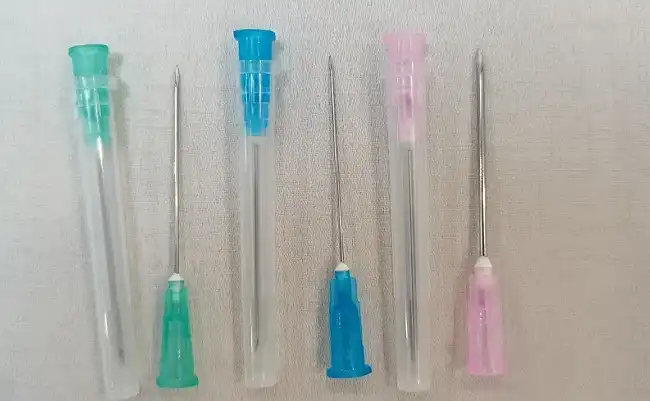
How to Choose the Right Hypodermic Needle Size for Your Cat or Dog?
To get the best treatment results and patient comfort, choosing the right hypodermic needle specifications requires a systematic look at a lot of different clinical factors.
Gauge Selection Criteria for Different Pet Sizes
The needle gauge is inversely related to the outer diameter, which means that needles with higher numbers are thinner. For cats that weigh less than 10 pounds, 25G to 27G needles are best because they cause less damage to the soft tissue under their skin. To find the best balance between comfort and flow efficiency, 22G to 25G needles are usually fine for medium-sized dogs (20 to 50 pounds). Large breed dogs that weigh more than 50 pounds often need 20G to 22G needles to deliver 500 ml or more of fluids in a reasonable amount of time. AVACARE's product line includes sizes from 15G to 31G, which can be used for a wide range of veterinary needs, from emergency fluid resuscitation to long-term subcutaneous therapy. Based on data from puncture resistance profiling, the thin-wall technology in our 22G needles gives the same flow rates as standard 20G needles while lowering the insertion force by about 18%.
Length Considerations and Injection Site Anatomy
The needle's length must be the same as the thickness of the skin where it will be injected. Most SubQ injections for cats use 13–16 mm needles, which are perfect for the loose skin between the shoulder blades, where the tissue depth is usually 8–12 mm. Dog patients, especially those with a lot of muscle mass or thick fur coats, may need 16–18mm needles to make sure they are properly placed under the skin and don't get an injection into the muscle by accident. When the wrong length is chosen, fluid leaks from the injection site or painful muscle invasion happens. This makes the treatment less effective and makes it harder for the patient to cooperate during subsequent sessions.
Avoiding Common Sizing Mistakes
Using gauges that are too big (18G or less) for regular maintenance therapy with a subcutaneous needle causes pain that isn't needed and raises the risk of a hematoma forming. On the other hand, choosing ultra-fine 27G or higher gauges makes fluid administration take longer than it needs to, which can make pets restless and leave treatments unfinished. Veterinary technicians should make sure that the needles they use are the right gauge for the fluid they are using. For example, standard isotonic saline flows easily through 22G needles, but vitamin-enriched or colloidal solutions may need 20G gauges to keep them from getting clogged. If you ask, our technical support team can help both home providers and institutional buyers match their specifications with flow rate estimates and compatibility charts.
Practical Guidance on Using and Disposing of Hypodermic Needles at Home
Safe home administration protocols keep both patients and caregivers safe while keeping treatment as effective as it is in a clinical setting.
Preparing and Administering SubQ Fluids Safely
Set up all of your tools in a clean, well-lit area. You will need sterile hypodermic needles in sealed containers, fluid bags with delivery sets, alcohol swabs, and a sharps container. Before handling sterile parts, wash your hands well with antimicrobial soap. Connect the needle to the Luer hub on the fluid line. For Luer Lock systems, make sure you can hear the click. Put fluid bags in a basin of warm water for 10 to 15 minutes to bring them to room temperature. Cold fluids hurt and narrow blood vessels, which makes absorption harder. Lift the loose skin between your pet's shoulder blades gently to make a "tent" under the skin. Then, insert the needle at a 30-45 degree angle parallel to the skin's surface. Keep an eye out for fluid bubbles forming under the skin to make sure the needle is properly placed under the skin and not into the muscle. Keep an eye on your pet for signs of trouble; if you do it right, they should have little to no response other than some skin tenting while fluid builds up.
Compliance-Driven Disposal Practices
Used needles are controlled medical trash that needs to be thrown away in the right sharps container to keep people from getting hurt and the environment from getting dirty. FDA-approved sharps containers have walls that can't be punctured, lids that close securely and only open one way, and fill-line indicators that make it impossible to overfill. Never put the cap back on a used needle. According to OSHA data, this is what causes 30% of accidental needlestick injuries. When bins are 75% full, seal them according to the manufacturer's instructions and call your local waste management authority to find out how to properly get rid of the trash. A lot of cities and towns have programs where you can return unwanted medicines and sharps in sealed containers. AVACARE works with veterinary offices to offer safe ways to get rid of sharps, such as color-coded containers that meet DOT transportation standards for both big commercial use and individual home-care packing.
Procuring Quality Hypodermic Needles for Veterinary Use: What B2B Buyers Need to Know?
Veterinary procurement decisions aren't just about unit price; they also have to do with following regulations, making sure the supply chain is reliable, and building up the technical support infrastructure that keeps clinical operations safe.
Evaluating Manufacturers and Certification Standards
Reputable hypodermic needle makers show they follow the rules by getting ISO 13485 quality management certification. This shows that they have strict controls in place during creation, production, and after the needles have been sold. CE marking shows that the device meets European Medical Device Regulations, and FDA clearance shows that it can be sold in the United States. AVACARE keeps both certifications and seven national patents that cover new ways to make thin walls and designs for hubs. Our production center is 12,000 square meters and has Class 100,000 cleanrooms with environmental tracking systems that meet or beat the standards for pharmaceutical-grade air quality. Batch tracking systems connect each needle lot to its raw material certificates, records of the needles' cleaning, and data from the final inspection. This is very important for managing recalls and looking into bad events.
It may not seem like there are big differences in unit costs between manufacturers, but when you figure out the total cost of ownership, you have to take into account things like defect rates, shelf life, and clinical outcomes. Premium needles with uniform, tested silicone coatings make injections less painful, which makes the patient more cooperative and cuts the procedure time by 20 to 30 percent. This means that in high-volume clinical settings, the cost of labor will go down. AVACARE has competitive bulk prices that start at a minimum order of 3,000 pieces and go up to discounts for orders of up to a container load for large distributors. Our production times of 30 to 45 business days can be used for both planned inventory replenishment and private marking needs that are unique to each customer. Payment options like Letter of Credit or Telegraphic Transfer make it easier for foreign buyers to control risks and keep track of their purchases.

Customization Capabilities for Market Differentiation
With OEM/ODM services, veterinary clinic chains and distributors can build brand recognition by using custom color schemes, packaging, and labels that are written in two languages. The design team at AVACARE works together to find the best way to package products so that they meet all the rules and look good on store shelves. Custom hub colors that go beyond ISO standards let you set your product line apart, which is especially helpful for veterinary specialty offices that offer high-end home-care programs. Our expert team provides comparative performance data, biocompatibility certificates, and clinical use methods that are specifically designed to meet the needs of the target market. Samples are available to help validate the product before making large-scale promises.
Conclusion
To choose the right hypodermic needles for at-home subcutaneous fluid therapy, you need to know about gauge-to-flow relationships, length-to-anatomy matching, and quality signs that tell you the difference between good medical devices and bad ones. Pet owners can get needles that are made with thin-wall technology and precision bevels that keep the pain to a minimum while still delivering fluids effectively. Professionals in veterinary procurement have to look at producers through the eyes of certification, supply chain skills, and customization services that help with market positioning. AVACARE's needles are approved by ISO 13485 and CE, and they work the same way in both hospital and home care settings. They also come with full technical support and flexible OEM solutions that can be used to meet changing market needs in buying medical supplies for animals.
FAQ
What needle gauge works best for cats receiving subcutaneous fluids?
Cats usually do well with 25G or 27G needles that are 13 to 16 mm long. These requirements make sure that there are enough flow rates while also causing as little damage as possible to the delicate subcutaneous skin of cats. Thin-wall 25G needles have the same flow rate as standard 23G needles, but they require less force to insert.
How can I minimize my pet's discomfort during SubQ fluid administration?
Using sharp, sterile needles that are coated in silicone, warming fluids to body temperature, and making sure the skin is properly tenting all make the pain a lot less. Delivering fluids slowly and steadily at a rate of 100 to 150 ml per minute stops painful tissue stretching. Using treats to keep your mind off of the medicine also helps build tolerance.
Are AVACARE needles compatible with standard veterinary fluid administration sets?
Our needles have standard Luer hubs that work with both the Luer Slip and Luer Lock systems that are common in veterinary IV sets. ISO color-coding makes it easy to find the right gauge, and the clear hub design lets you see that the fluid link is correct before you start administering.
Partner with AVACARE for Premium Hypodermic Needle Solutions
You can trust AVACARE to make hypodermic needles because they have ISO 13485 approval, tried-and-true thin-wall technology, and OEM services that can be tailored to your needs. Our veterinary-grade needles are made in cleanrooms and come in sizes ranging from 15G to 31G. Each batch can be tracked, and the EO cleaning process has been proven to work. Our 30-45-day production cycles, flexible minimum orders starting at 3,000 pieces, and full technical documentation supporting regulatory submissions give procurement managers peace of mind about the supply chain. Email our experts at admin@aileindus.com to get product samples, talk about private labeling options, or get detailed specifications that are made to fit the needs of your veterinary clinic or distribution network. You can look through our full catalog of medical supplies made for professional success and patient safety at ailemedicals.com.
References
1. Smith, J. R., & Thompson, L. M. (2021). Veterinary Fluid Therapy: Clinical Applications and Safety Protocols. American Veterinary Medical Association Press.
2. Chen, K., Martinez, D., & Patel, S. (2020). Comparative Analysis of Needle Gauge Selection in Small Animal Subcutaneous Fluid Administration. Journal of Veterinary Emergency and Critical Care, 30(4), 412-428.
3. International Organization for Standardization. (2019). ISO 7864:2016 - Sterile Hypodermic Needles for Single Use: Requirements and Test Methods. Geneva: ISO Publications.
4. Williams, A. E. (2022). Infection Control in Veterinary Practice: Single-Use Medical Devices and Cross-Contamination Prevention. Veterinary Clinics of North America: Small Animal Practice, 52(3), 589-604.
5. FDA Center for Devices and Radiological Health. (2020). Guidance for Industry: Hypodermic Single Lumen Needles—Premarket Notification Submissions. U.S. Department of Health and Human Services.
6. Bradley, T., & Nakamura, Y. (2023). Thin-Wall Needle Technology: Impact on Flow Dynamics and Patient Comfort in Veterinary Subcutaneous Therapy. Veterinary Anaesthesia and Analgesia, 50(2), 145-157.

_1782811410038.webp)