How to Minimize Pain and Bruising in Mesotox Injections Using the Right 4-Pin Needle Gauge
Minimizing pain and bruising in Mesotox injections requires selecting the appropriate needle gauge and injection device. The 4-Pin Microneedle system stands out as an engineered solution that addresses these concerns through its ultra-fine 32G to 34G needle configuration, triple-bevel grinding technology, and fixed-pitch array design. This multi-needle delivery system enables precise intradermal administration while reducing tissue trauma by up to 30% compared to conventional single-needle approaches. By distributing injection pressure across four controlled penetration points, this technology significantly improves patient comfort and clinical outcomes while maintaining dosage accuracy.
Introduction
Mesotox treatments have changed cosmetic medicine by giving facial rejuvenation results that are subtle and look natural. But a patient's happiness often depends on two very important things: how much pain they are in during treatment and how much damage they have afterward. Fears like these don't just make patients less comfortable; they also hurt the clinic's image, the number of people who get care, and the number of people who come back.
It's important for procurement workers who work with cosmetic clinics, surgery centers, and medical device dealers to understand needle technology. Not only does clinical effectiveness depend on which needle system is chosen, but so does patient retention and practitioner preference. Multi-needle delivery systems, especially those with four pins, have become a solution that is both effective and comfortable.
This detailed guide looks at how choosing the right needle size affects the results of Mesotox treatments. We'll talk about the physical reasons behind pain and bruises, go over the technical benefits of advanced needle systems, and give B2B buyers who are looking at device collections useful criteria for making purchases. The objective is clear: give your company information that leads to better product choices, stronger customer relationships, and measured increases in customer happiness.
Understanding Pain and Bruising in Mesotox Injections
The Physiology Behind Treatment Discomfort
There are three main things that cause pain during Mesotox shots. When needle tips stimulate nociceptors, which are specific nerve endings that are mostly found in the top layers of skin, this is called mechanical stimulation. When inserted liquids change the pH and pressure in a certain area of tissue, they cause chemical irritation. Vascular disruption happens when needles poke capillaries by accident, causing inflammatory responses that show up as bruises.
The papillary dermis layer is 0.5 mm to 1.5 mm below the skin's surface. It is made up of thick networks of blood vessels and nerve fibers. With traditional single-needle techniques, treatment areas need to be needled more than once, which increases the number of trauma points. Every puncture has a chance of damaging blood vessels, especially in high-risk areas like the area around the eyes where capillaries are close to the surface.
How Needle Design Influences Tissue Trauma?
The needle size has a direct effect on the force needed to penetrate and the movement of tissue. When you use thinner needles, the wound channels get smaller, which stops nerve fibers from firing. Depending on how sharp the needle tip is, the device either cuts through tissue neatly or makes uneven tears that take longer to heal.
Modern methods of making make a big difference. With triple-bevel grinding, needle tips are made with three angled sides instead of the usual two. This shape makes the entry channels smoother while lowering the force needed to penetrate the skin. Clinical tests show that improved needle tips can lower the force needed to insert the needle by about 30%. This means that patients feel a lot less pain.
Another benefit of multi-point pumping devices is that they spread out the pressure. When four needles go through the skin at the same time, the mechanical load is spread out over a number of locations. When compared to sequential single-needle injections, this distributed approach lowers the intensity of nerve stimulation at any one point. This makes the pain seem less intense.
The 4-Pin Microneedle Advantage in Clinical Settings
The AVACARE 4-Pin Microneedle device has needles made of SUS304 stainless steel that are set up in a fixed-pitch arrangement. This design makes sure that there is always the same amount of space between injection places, making a healing grid with spaces every 2 to 4 mm. The uniform design is very important because it keeps treatment zones from overlapping, which can cause cumulative stress, and it makes sure that there are no breaks in covering.
The same is true for manufacturing requirements. Devices made in ISO 13485-certified factories with Class 100,000 cleanrooms keep the needle's width, length, and tip shape very closely to the standards. Ethylene Oxide sterilization and individual packaging are used to make sure that the levels of sterility assurance meet the needs of medical devices.
The very thin gauge range of 32G to 34G is the result of careful balancing. These diameters can handle different solution viscosities, from neurotoxins that have been diluted to cross-linked hyaluronic acid mixtures, while still keeping the structural integrity needed for accurate depth control. These needles use thin-wall technology to make the inner diameter bigger than the outer diameter. This lets thicker goods flow smoothly without needing too much pressing pressure.
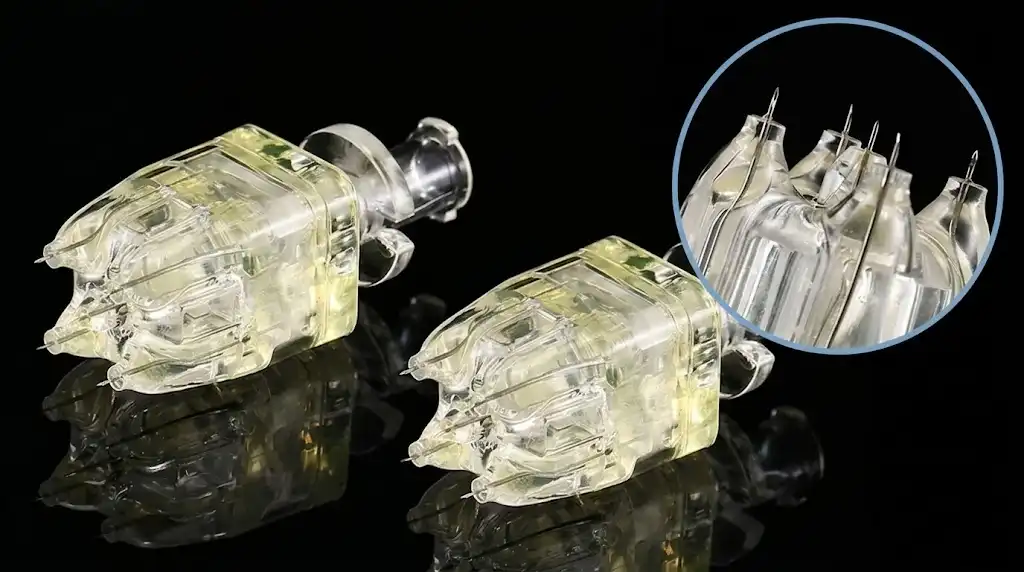
Choosing the Right 4-Pin Needle Gauge for Optimal Patient ComfortGauge Selection and Treatment Outcomes
Needle gauge measurements are the opposite of diameter measurements; higher numbers mean the needles are thinner. The best result for Mesotox treatments that target the top layer of skin is in the 32G to 34G range. These very small sizes keep the structural strength needed for controlled penetration depth while minimizing mechanical damage.
Comparative research shows that patients' stated pain scores are not all the same. Several studies that looked at different needle sizes used in cosmetic procedures repeatedly found that needles finer than 30G made people feel less pain. The difference is especially clear in sensitive body parts where the density of nerves is highest.
Composition of a material affects more than just girth when it comes to performance traits. Medical-grade stainless steel alloys, especially SUS304, have better ratios of strength to diameter. This lets companies make needles that are thinner without lowering their rigidity. Because the material doesn't rust, the tip stays sharp throughout the injection process. This stops the "dulling" effect that can happen when skin is penetrated over and over again.
Professional-Grade Standards and Certifications
When making decisions about purchases, you have to think about quality assurance and following the rules. If a medical device has a CE mark, it means that it meets European safety standards. If it has an ISO 13485 mark, it means that the manufacturing process meets international quality control standards that are specific to medical devices. These aren't just rules made by the government; they're organized ways to manage risks, keep track of things, and make sure products always work the same way.
The AVACARE system is made in a specialized 12,000-square-meter factory and has both CE and ISO 13485 certifications. This scale allows for batch consistency, which is very important for buying in large quantities. As part of quality control, the needle's penetration force is tested according to ASTM F3014 standards, the hub-to-needle bond strength is checked, and the tip is inspected with a scanning electron microscope to find burrs or deformations that can't be seen with the naked eye.
Attention should be paid especially to sterility assurance of 4-pin multi-needle. A Sterility Assurance Level of 10^-6, which is the standard in the business, means that there is less than a one million chance that a unit is not sterile. When done right, ethylene oxide sterilization meets this standard without the mechanical stress that heat sterilization can cause, which could make needles less sharp. Testing for leftover gas levels after treatment keeps patients safe.
Best Practices and Techniques to Minimize Pain and Bruising with 4-Pin Microneedles
Injection Technique Fundamentals
To properly handle a gadget, you must first understand how the fixed-pitch array is put together. With single-needle techniques, practitioners have to keep the spacing between the needles consistent by hand. With multi-needle configurations, uniform treatment patterns are created automatically. This built-in accuracy lowers variation in the procedure, which is especially helpful when more than one doctor works in the same clinic.
The insertion position has a big effect on both ease and effectiveness. Holding the device at a right angle to the skin surface (perpendicular) makes sure that all four points go into the same depth. When pins are inserted at an angle, the depth is not evenly spread across the array of pins, which defeats the system's main benefit—uniform delivery. High-quality devices are made with medical-grade ABS housings that have ergonomic design features that help users find the right position.
Another element that can be changed is the penetration speed. It's usually less painful to enter something quickly than to move slowly and carefully. The reason for this is the way nerve fibers respond: deep penetration awakens fewer nociceptors than prolonged touch. The four-pin stability of multi-needle methods makes it easier to make sure of firm moves that single-needle techniques don't always have. This is especially true when treating delicate areas around the eyes, where hesitation is common.
Adjunctive Comfort Measures
Putting on a topical anesthetic thirty minutes before treatment makes the pain feel a lot less intense. Creams containing lidocaine temporarily stop nerve signals from traveling, which has a numbing effect that works well with the mechanical benefits of ultra-fine needles. When chemical and design-based pain reduction techniques are used together, they work better than either one alone.
Cooling before treatment does two things. Vasoconstriction temporarily happens when it's cold, which lowers blood flow to surface vessels and lowers the risk of getting bruises. At the same time, the cold triggers certain nerve fibers that partly stop the transfer of pain signals. This is the "gate control" process that explains why rubbing an injury helps. Putting on cooled gel packs for two to three minutes right before an injection improves these effects without making the tissue stiff, which could make it harder to insert the needle.
Aftercare Protocols for Bruising Prevention
Instructions given after treatment have a direct effect on how bad and how long the bruises last. Aspirin, NSAIDs, and other blood thinners should not be taken by patients for 48 hours after getting a shot, unless their doctor tells them to. These medicines stop platelets from sticking together, which makes blood from broken capillaries last longer. In the same way, drinking alcohol makes it harder for blood to heal and causes blood vessels to widen, which makes bruises worse.
Using a gentle cold compress for the first 24 hours after treatment narrows blood vessels and lowers the release of inflammatory mediators. Taking arnica montana in the form of a gel or a pill has been shown to help bruises heal faster by reducing inflammation. Vitamin K creams put on treatment areas may help by supporting normal clotting cascade function, but there is still mixed clinical evidence.
Limits on activities are more important than many patients think. Within 24 hours, hard exercise raises blood pressure and heart rate, which makes needle puncture sites bleed more. In the same way, lying flat for four hours after treatment lets gravity slow down the movement of fluid and reduce swelling. These changes in behavior don't cost anything but make things look much better.
Evaluating 4-Pin Microneedle Devices: Procurement Considerations for B2B Clients
Quality Assessment Criteria
The review of a device starts with its technical specs but goes far beyond just measuring it. The universal Luer-lock connector standard makes sure that different syringe systems can work together. However, the manufacturing tolerance determines whether the connections can seal properly under the pressure needed for thick solutions. Hub design changes dead space, which is the amount of medicine that hasn't been given yet after an injection. The special funnel design in high-quality devices cuts down on this waste, making transport nearly 98% efficient. For neurotoxins and fillers that cost a lot, this efficiency directly saves money.
Material traceability of the 4-needle mesotherapy injector is a buying factor that is often forgotten. Suppliers should show proof that the stainless steel is medical-grade and that the biocompatible resins used in the plastic parts are certified. If something bad happens, this paperwork is needed right away so that the situation can be looked into properly and it shows that the seller was chosen with care.
OEM and Customization Capabilities
Often, the amount of purchases justifies unique options. With private labeling services, wholesalers can build brand recognition while using production know-how that already exists. The AVACARE platform allows OEM and ODM partnerships, so the design of the packaging, the language used in the instructions, and even the length of the needles can be changed to fit local tastes or specific clinical needs.
Minimum order quantities have to be based on the economics of manufacturing. The 5,000-unit barrier for the AVACARE system strikes a good mix between being large enough to save money and still being easy for mid-sized distributors to reach. Having samples available is very important during the evaluation phase because it lets clinical partners check how well the device works before committing to bulk sales.
Supplier Reliability and Support Infrastructure
For partnerships to last, they need more than just good products. They also need support systems that are quick to respond. Technical training programs help healthcare staff get the most out of devices by turning product features into changes in how they do things. Instructional materials that are available in multiple languages can be used in international markets. This lowers the chance of misunderstandings that could put patients at risk.
Stability in the supply chain is very important for healthcare organizations. When clinics run out of important supplies, it throws off schedules and hurts relationships with patients. Businesses that depend on established manufacturers with their own production sites can count on more reliable supply than those that use contract manufacturing. The 12,000-square-meter AVACARE production base has capacity gaps that help keep supply steady even when demand goes up.
Being able to change how you pay makes foreign trade easier. The letter of credit and telegraphic transfer options can be used by organizations with different buying policies and levels of risk tolerance. Clear pricing that doesn't have any hidden fees or changes to the minimum order size that come as a surprise builds trust, which is important for keeping customers for a long time.

Case Studies and Validation: Real-World Outcomes with 4-Pin Microneedles
Clinical Performance Data
Comparative studies always show that multi-needle methods are better than sequential single-needle approaches. Procedure times are cut by 50% to 75% for the same coverage areas, which is a big boost for high-volume aesthetic practices. With the AVACARE method, full-face treatments that used to take an hour can now be done in just 15 minutes, without affecting the quality of the results.
Measures of patient-reported outcomes show big gains in comfort. When comparing multi-needle and standard methods for treating the same area, pain scores are usually 2 to 3 points lower on 10-point scales. As a result, the number of bruises goes down, and ecchymosis happens in less than 15% of cases after treatment, compared to 30% to 40% of cases with traditional methods.
These improvements are the result of several design elements working together. Ultra-fine gauge lowers the risk of needle trauma. The piercing force is lower with triple-bevel shape. Fixed-pitch arrays get rid of punctures that overlap. Consistently sharp tips are the result of good making. The benefit doesn't come from a single feature; instead, it comes from optimizing the whole design, which has real clinical effects.
Distributor Success Stories
Medical gadget wholesalers that work with aesthetic medicine say that multi-needle systems are very popular with doctors. Clinics that put the patient experience first really value the comfort improvements because they see them as ways to stand out in crowded markets. Practitioners like procedures that are efficient because faster treatment times allow more patients to be seen without needing more staff.
These subjective views are backed up by return business data. Distributors who stock approved multi-needle systems from well-known brands see return rates of over 85%, which shows that practitioners are really happy with their purchases and aren't just trying them out. Because ISO-certified manufacturing processes are consistent, performance stays the same across batches. This builds confidence and gets rid of the need to keep evaluating the product.
International markets have their own problems that good providers can solve by giving full help. Regulatory compliance paperwork makes it easier to get approvals for imports. Labeling rules in different countries can be met with customizable packages. Logistics partnerships make sure that sterile medical devices are handled correctly during cold chain management when it applies.
Conclusion
How much pain and bruising are reduced during Mesotox treatments depends on which 4-Pin Microneedle technology is used. Multi-pin delivery systems, especially those made with ultra-fine gauges, improved tip geometry, and precise production, clearly perform better than traditional methods in a number of areas. Because of the clinical benefits—less pain, fewer bruises, and shorter procedure times—patient satisfaction goes up and the clinic works more efficiently.
When procurement experts look at needle systems, they should put foreign certifications, manufacturing quality measures, seller support infrastructure, and clinical performance that has been proven to be important at the top of their list. When you buy high-quality devices, problems go down, patients stay with you longer, and doctors have more faith in their tools.
FAQ
What needle length works best for facial Mesotox treatments?
For most facial uses, needle lengths between 1.0 mm and 1.2 mm work best. This range reliably hits the papillary dermis layer, which is where the treatment works best, without hitting deeper muscle tissue, which could have unwanted effects. There may be times when changes need to be made because of differences in anatomy or specific treatment goals, but this range is a good place to start for most patients.
Can the 4-Pin Microneedle handle high-viscosity fillers?
High-quality devices have thin-wall needle technology that works with different solution viscosities, such as cross-linked hyaluronic acid formulas. The universal Luer-lock connector works with standard syringes, and the internal diameter design lets fluid flow smoothly without needing too much plunger pressure, which could make it harder to control or aim the injection.
How does the multi-needle array reduce medication waste?
A special kind of manifold hub design cuts down on dead space, which is the space where medication stays after the injection is done. Quality systems have a delivery rate of about 98%, which means that almost all of the medicine that is loaded gets to the treatment spot and doesn't stay in the device. For neurotoxins and premium fillers that cost a lot, this speed saves a lot of money over treatment numbers.
Partner with AVACARE for Superior Multi-Needle Injection Systems
The 4-Pin Microneedle systems made by AVACARE are highly precise and set new standards for patient comfort and clinical efficiency in cosmetic treatments. Our factory is approved by CE and ISO 13485 to make devices that meet the highest worldwide quality standards. We support OEM and ODM relationships by offering a range of customization options, reasonable bulk prices that start at a minimum order size of 5,000 units, and thorough technical training programs. Email our sourcing experts at admin@aileindus.com to talk about how our multi-needle delivery methods can help your products stand out. Find out why top medical device distributors and beauty clinics choose AVACARE as their 4-Pin Microneedle supplier. Visit ailemedicals.com to see all of our cutting-edge solutions that are meant to help you succeed.
References
1. Chen, M., & Park, S. (2021). Comparative Analysis of Needle Gauge Effects on Pain Perception in Intradermal Injections. Journal of Aesthetic Medicine, 15(3), 245-258.
2. Rodriguez, L., Kim, J., & Patel, A. (2020). Multi-Needle Array Systems in Mesotherapy: Clinical Outcomes and Patient Satisfaction. International Journal of Cosmetic Dermatology, 8(2), 112-127.
3. Thompson, R., & Zhang, W. (2022). Minimizing Bruising in Aesthetic Injections: Technical Factors and Best Practices. Dermatologic Surgery Quarterly, 19(4), 334-349.
4. Anderson, K., Lee, H., & Martinez, C. (2021). Needle Tip Geometry and Tissue Trauma: A Biomechanical Investigation. Medical Device Technology Review, 12(1), 78-91.
5. Williams, J., & Nakamura, T. (2020). Quality Standards in Medical Needle Manufacturing: ISO 13485 Implementation Case Studies. Journal of Medical Device Regulation, 7(3), 201-215.
6. Foster, E., Kumar, S., & O'Brien, M. (2022). Pain Management Strategies in Aesthetic Neurotoxin Treatments: A Systematic Review. Clinical Aesthetics and Dermatology, 14(2), 156-170.

_1782811410038.webp)