Retractable vs. Shielded: Which Type of Disposable Safety Needle is Best for Your Clinic?
Choosing between retractable and shielded disposable safety needles requires careful analysis of both clinical requirements and procurement priorities. While retractable needles offer automatic protection through a spring-loaded mechanism that withdraws the cannula into the barrel immediately after injection, shielded needles provide a sliding or hinged cover that isolates the sharp post-use. The optimal choice depends on your clinic's injection volume, staff training protocols, and budget constraints. Both designs significantly reduce needle-stick injuries compared to conventional needles, yet their performance in real-world clinical workflows varies considerably based on procedural context and user competency.
Introduction
Needle-stick injuries remain a major healthcare workplace danger. They expose doctors and nurses to HIV, Hepatitis B, and C. The US Centers for Disease Control and Prevention report 385,000 needle-stick injuries to hospital personnel annually. Due to its built-in safety measures that activate during or after usage, disposable safety needles changed infection management.
Clinic procurement managers must assess clinical performance, staff acceptance, regulatory compliance, and total cost of ownership when deciding between retractable and shielded disposable safety needle technologies. This decision immediately impacts patient safety, worker health, and supply chain stability. Knowing the technical distinctions between these two key safety designs helps healthcare facilities make sensible purchase decisions that benefit patients and the budget.
Understanding Disposable Safety Needles: Retractable vs. Shielded
As a major step forward in medical sharps technology, disposable safety needles were created to address the long-term risks that come with using regular hypodermic needles. These devices have built-in safety features that cover or greatly reduce the sharp cannula after clinical use. This keeps healthcare workers from getting accidental stab cuts and potentially spreading pathogens.
Regulatory Standards and Compliance Framework
Retractable and shielded disposable safety needles must meet international standards to protect patients and professionals. Healthcare facilities must employ safety-engineered sharps under the US Needlestick Safety and Prevention Act. EU Directive 2010/32/EU sets uniform requirements for member states. Manufacturing standards include ISO 13485 for medical device quality management systems, ISO 7864 for sterile hypodermic needles, and ISO 80369 for small-bore connections. CE and ISO 13485 certifications prove 、safety needles fulfill global requirements. As Class II medical equipment, it undergoes extensive pre-sale testing and continuing quality monitoring.
Core Safety Mechanisms Explained
Retractable disposable safety needles work with a spring-loaded syringe tube. Once the injection and medicine are given, the user applies a little pressure to make the spring pull the needle back into the barrel. After activation, the needle can't be touched again, providing passive protection. The mechanism is precision engineered to maintain activation forces and retract entirely over gauge sizes from 18G to 30G.
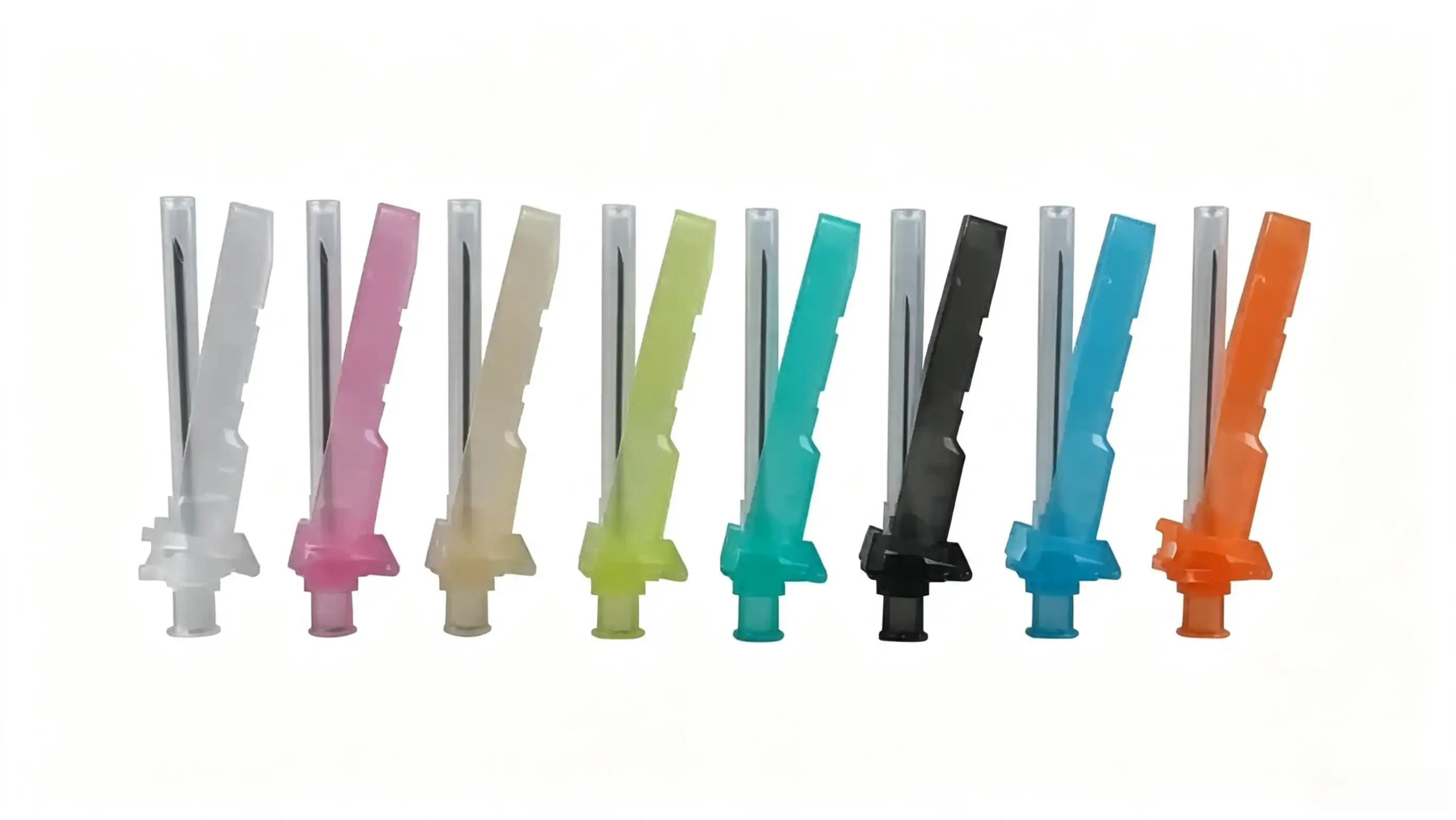
Shielded disposable safety needles have a protective sleeve around the needle tip after use. Some protective designs activate automatically when the device is removed from the patient, while others require manual engagement, usually by sliding the device with one hand. The shield clicks into place, confirming activation visually and audibly. It can be used with stock syringes because it maintains the regular split between the syringe and needle.
Material Specifications and Manufacturing Quality
Premium disposable safety needles feature medical-grade SUS304 stainless steel cannulas. These needles have ultra-thin walls for high flow rates and structural integrity during penetration. Medical-grade polymers without DEHP and heat make the needle hub and safety parts. ISO 10993 biocompatibility requirements for cytotoxicity, sensitization, and systemic toxicity are met. AVACARE precisely grinds needle bevels to prevent entry force and tissue injury. Injection needles are also made more comfortable with medical-grade silicone. Our EO gas sterilization method reaches a Sterility Assurance Level of 10⁻⁶, ensuring microbe-free packaging for each product.
Key Differences Between Retractable and Shielded Disposable Safety Needles
Knowing how these two disposable safety needle technologies work differently helps clinical directors and procurement managers choose products that work well with specific clinical processes and user preferences. The differences go beyond the machinery that can be seen and include things like comfort, training needs, and compatibility.
Design Architecture and Activation Methods
For retractable needles, the safety mechanism is built into the syringe. This unites the needle and syringe. Mechanism activation following pharmaceutical delivery normally requires controlled pressure. This removes the cannula. This design eliminates sharp edges after activation, ensuring disposal safety. For hospitals with many patients, the compact sharps containers reduce volume.
Shielded needles usually separate the needle and syringe; the needle hub has a safety screen. The safety cover slips forward or hinges over the needle tip manually or automatically when the needle is withdrawn. This modular design gives you more syringe options and makes it easier to find needles that can link to Luer Lock or Luer Slip syringes.
Ergonomic Considerations and Ease of Use
Clinical professionals typically accept safety features based on how well they fit into injection protocols. People who use retractable needles must be able to distinguish between medicine delivery and safety feature activation. This may take some getting accustomed to. Once they learn it, many professionals like how well it fits with other operations and how permanent the retraction mechanism is.
The injection technique is the same with shielded needles until the safety is activated, making them easier to handle. AVACARE's protected disposable safety needles may be actuated with one hand, which helps doctors and nurses in emergency departments and immunization clinics keep patients' attention or multitask. The new closing structure ensures that the mechanism functions even when staff are rushed or working in hard-on-bodies environments.
Compatibility Across Clinical Applications
Compatibility depends on gauge supply. AVACARE's disposable safety needles from 16G to 30G can be used for blood drawing, IV therapy, insulin under the skin, and muscle immunizations. Standard retractable and protected syringes work nicely. Shielded needles allow syringe interchangeability; however, retractable systems are usually single units.
The ultra-sharp, thin wall construction of our disposable safety needles ensures exceptional penetration across all gauge sizes. This reduces placement pushback, making the patient more comfortable. This is crucial for older adults and children with fragile tissues who need gentle insertion. The precision-ground bevel shape ensures the needle passes through tissue neatly and without harm, regardless of the safety device. This improves clinical outcomes.
Cost Analysis and Market Positioning
Unit cost often distinguishes disposable safety needle solutions for purchasing managers. Retractable needles cost more due to their sophisticated spring mechanisms and syringe design. This initial price difference must be balanced against the savings on sharps containers, disposal fees, and post-exposure prophylaxis due to enhanced safety.
Shielded disposable safety needles are cheaper and safer than normal needles. Schools that already stock standard syringes may benefit from buying needles and syringes separately to reduce inventory and costs. Clinic chains and hospital networks who want to acquire safety needles in bulk can afford AVACARE's minimum order quantity of 20,000 pieces.
Choosing the Best Safety Needle for Your Clinic: Decision-Making Criteria
To choose the right disposable safety needle technology, you need to carefully look at a lot of different operational and clinical factors. Procurement managers, clinical directors, infection control officers, and frontline healthcare workers who will use these devices every day should all have a say in this decision.
Clinical Environment Assessment
Vaccination clinics for patients stress speed and efficiency. In these cases, shielded disposable safety needles that activate automatically decrease shot-related steps. User-friendly features shorten the annual vaccination program's temporary worker training time. ERs and ICUs struggle with space and clearing items rapidly. For these situations, retractable needles are safe and fit in the sharps container better.
Specialized procedural rooms with protected needles simplify blood draws and IV access. After use, the needle can be removed from the syringe for multi-step sample transfer or medication production. Surgical centers and operating rooms prefer retractable systems for safety activation and needle exposure reduction during complex operations with several crew.
Staff Competency and Training Requirements
How effectively consumers accept a safety system determines its effectiveness. If clinical personnel don't use security technologies effectively and regularly, it doesn't matter how advanced. AVACARE's technical training programs include multilingual instructions, demo films, and on-site workshops tailored to your facility's operations and personnel skill levels to ensure a seamless launch.
The retractable safety hypodermic needle must not be triggered too early or not fully withdrawn. Staff must be able to read tactile feedback indicating proper mechanism operation. For injection specialists who are comfortable with ordinary needles, protected needles usually require less training. Our shielding design's loud click confirmation confirms safety feature locking, reducing uncertainty and boosting cooperation.
Supply Chain and Procurement Considerations
Long-term supply stability is crucial for healthcare buyers. Avoid stock-outs that could harm patient care by partnering with approved makers who maintain production capacity and shipping plans. AVACARE has a 12,000-square-meter production facility with 100,000-class clean rooms. This ensures the organization can produce high-quality items throughout time.
Planning for frequent replenishment and last-minute purchases is easy with our 30- to 45-day return policy. OEM and ODM services allow institutional buyers to adjust product packaging, labeling, and specs to satisfy market regulations or practical demands. Different healthcare systems need variable payment terms like L/C and T/T since their financial operations and purchase policies vary.
Regulatory Compliance and Quality Assurance
Quality control officers value lot stability and traceability. Full batch paperwork tracks every AVACARE disposable safety needle from raw materials to sterilization. Our ISO 13485-certified quality management system checks penetration force, safety mechanism activation stability, and hub-to-cannula bonded strength. Safety mechanism failure rates remain significantly below industry standards, according to regular AQL sampling. Healthcare environments get zero-defect reliability.
CE accreditation proves we meet European and FDA quality system standards. Global hospital groups and worldwide healthcare organizations with multiple regulatory jurisdictions can acquire more easily with this dual certification. Individual boxes with EO gas sterilization prevent tampering and maintain sterility during storage and delivery.

Benefits and Limitations of Retractable and Shielded Safety Needles
For a balanced evaluation to be complete, both the pros and cons of each disposable safety needle design must be honestly considered. In the real world, performance depends on implementation quality and staff engagement just as much as it does on the technical aspects themselves.
Retractable Safety Needle Advantages
The finest thing about retractable technology is security. The needle is unreachable after pressing the button. This protects people from needles when disposing of trash. This is helpful when environmental services handle sharps containers or remove them outside hospitals. Smaller post-use forms minimize sharps waste by 30% over shielded designs. Waste management costs drop, and sharps containers may need less updating.
When using multiple-dose vials, retractable disposable safety needles avoid cross-contamination because they don't touch surfaces. The integrated design simplifies trash sorting by eliminating needle and syringe garbage cans. Retractable needles prevent injuries in high-risk departments, according to clinical trials. Training and persistent activation are essential for these outcomes.
Retractable Safety Needle Limitations
The novel technology costs more per unit than disposable safety needles or conventional needles. Procurement managers monitoring budgets must also consider medical bill and waste removal reductions. The combined needle-syringe design precludes institutions from using different needles and syringes for operations or inventory optimization.
Some practitioners find it difficult to establish retraction activation pressure, especially when using smaller gauge needles or treating young or old patients with minimal drugs. Well-made devices rarely retract incompletely, but they need clear handling instructions. Some designs increase dead space volumes, wasting small amounts of valuable biologics or vaccines.
Shielded Safety Needle Advantages
Healthcare facilities looking to cut costs prefer shielded needles because they are safer and cheaper. The modular design lets purchasing teams preserve standard needle gauges and switch syringes for varied clinical uses, reducing inventory. Wholesalers and group buying groups that serve many consumers benefit from this versatility.
Staff learn faster and train easier with the simple handling features. The one-handed activation mechanism of AVACARE allows clinicians to use the safety shield without letting go of their hold. This aids busy clinical workflow. A crisp click sound and visible shield position establish device activation, reducing clinician doubt and helping them follow safety standards.
Shielded Safety Needle Limitations
Although shielded needles are safer, clinicians can use them until the safety mechanism activates. If the clinician is distracted, needle sticking can occur between injection completion and shield activation. Safe application requires proper technique, which must be taught and monitored.
Due to their bigger profile, protected needles require larger sharps containers and more waste. Shields can hide medication or partially block injection sites. Due to rigorous engineering, AVACARE's designs have reduced these concerns. Mixing needles and syringes from different manufacturers without checking their specifications could cause assembly issues.
Real-World Implementation Insights
Retractable needles at large hospitals reduced high-risk accidents by 60%. Training and change management were expensive, but they worked. Retraction's ultimate protection worked well in emergency rooms, where environmental stressors enhance injury risk. Inexperienced staff at these institutions first resisted activation. Transformation required fully dedicated leadership.
Shielded disposable medical safety needles are accepted faster and work flows more quickly in ambulatory clinics and community health centers. They were used in flu vaccine campaigns and blood draws due to their lower unit costs. Even though retractable needles worked better, injury rates were lower. Keeping syringe inventories during changeover lowered costs and facilitated logistics.
Procurement Guide: How to Source Disposable Safety Needles Effectively?
To buy disposable safety needles strategically, you need to know how the market works, what your suppliers can do, and the total cost of ownership, which is more than just the price per unit. Partnerships that work well for sourcing not only give goods but also full supply chain solutions that help clinical operations.
Evaluating Supplier Capabilities and Certifications
Quality-focused disposable safety needle firms like BD, Terumo, Smiths Medical, and Merit Medical invest much in R&D and follow global norms. Procurement specialists should check vendors' ISO 13485-certified quality control systems for medical equipment. A CE or FDA license enhances your confidence in following rules and marketing your product.
AVACARE's in-house research and production make us competitive. Our experts specialize in material science and therapeutic applications. They prioritize clinical needs over technology while developing new products. Our seven national patents safeguard our creative, reliable solutions. Our sample policy permits clinical testing before big commitments. Testers of new vendors or goods have less procurement risk.
Pricing Models and Bulk Purchase Strategies
Complexity, manufacture, and extras determine disposable safety needle prices. Annual quantities with a chosen supplier can get you tiered pricing that lowers per-unit prices. This 20,000-piece minimum order is for institutional buyers, hospital networks, and delivery partners who need lots of inventory. It boosts industrial efficiency and is affordable for medium-sized healthcare enterprises.
The total cost of ownership exceeds unit pricing. Training, waste removal, medical bills, and inventories are included. Retractable needles cost more but produce fewer sharps, making them cheaper to trash. Shielded disposable needles are safe and affordable. These qualities should be examined over numerous years by procurement teams to determine their economic impact. Volume contracts of 12–24 months may provide better prices and a steady supply.
Ordering Process and Supply Chain Optimization
Communication about gauge range, packing demands, cleaning techniques, and delivery dates is key to successful buying. AVACARE accepts OEM and ODM orders, so packaging, labelling languages, and product specifications can be altered to match institutional or regional regulatory norms. Global healthcare companies that acquire in many markets benefit from this independence.
When lead times are 30 to 45 days, you must plan ahead and track your goods using yearly demand changes. Vaccination clinics preparing for flu season or public health risks should start buying early. Backup stock—usually 20–30% of monthly consumption—protects against demand spikes and supply chain issues. Distributors with many healthcare clients should create rolling projections that encompass all institution needs. This will simplify purchases and empower them to set prices.
Building Strategic Supplier Partnerships
Long-term sourcing success requires relationships beyond procurement. Preferred vendors should offer clinical training, product demos, and fast customer service. No matter the time zone or business hours, AVACARE's rapid response system addresses questions, concerns, and urgent needs 24/7. Our extensive technical training reduces the dangers of integrating new medical equipment into hospital systems.
Healthcare emergencies and demand spikes require supply chain reliability. Suppliers with a large manufacturing capacity, recognized quality procedures, and many shipping choices can handle challenges better. Our 12,000-square-meter production unit can handle regular and urgent orders without affecting quality or delivery schedules. Letters of credit and telegraphic transfers help accommodate healthcare system finances and international procurement laws.

Conclusion
Shielded or retractable disposable safety needles depend on your clinic, patients, and budget. For high-risk regions where increased safety is worth the cost, retractable systems offer higher protective profiles and dumping efficiency. Shielded needles are safe and cheap, making them suitable for many professional applications. Both technologies avoid needle-stick accidents more than ordinary needles, but they require training and ability to use well. Suppliers must be evaluated beyond unit costs for successful procurement. Their ability to follow rules, create solid supply chains, give technical support, and form long-term relationships must also be assessed.
FAQ
Can We Transition Between Needle Types Without Additional Training?
The goal of both retractable and shielded disposable safety needles is to keep people from getting hurt, but they work in very different ways. To make sure that staff members understand the right way to do things for each design, transitioning needs specific training. AVACARE offers a wide range of training tools, such as manuals in multiple languages and instructional films that help people learn faster. Most healthcare workers are able to get used to it after two to four weeks of regular use. However, supervised practice during the initial implementation improves the consistency of activation and safety outcomes.
What Are the Compliant Disposal Methods for These Devices?
Both retractable and shielded disposable safety needles need to be thrown away in cases that can't be punctured and meet government standards. Needles that have been retracted stay inside the barrels of their syringes, and needles that have been protected keep their protection covers on until they are thrown away. Don't bend, recap, or take off safety features before throwing them away. Containers for sharps should be sealed and thrown away by approved medical trash services that follow environmental rules. The permanently locked safety mechanisms keep people from getting hurt while moving and handling trash.
Do All Gauge Sizes Perform Equally Across Both Designs?
The performance of AVACARE's disposable safety needles stays the same across all of our gauges, from 16G to 30G. Larger gauges, like those used for IV therapy and collecting blood, work effectively in both protected and retractable designs. For subcutaneous injections with smaller gauges, you may need to be a little more careful with how you activate the mechanism, but our optimal design reduces this. During the sample testing process, clinical review of specific gauges that are important to your procedures proves that the gauges will work with your workflows.
Partner With AVACARE for Superior Safety Needle Solutions
Certified disposable safety needle options from AVACARE meet the complex needs of modern healthcare buying. Our wide range of products, from 16G to 30G, are used in a wide range of hospital settings, from blood collection to immunization programs. All of them are made in ISO 13485-certified clean rooms that meet the highest international standards. As a safety needle supplier with a lot of experience, CE certification, and a track record of a reliable supply chain, we help healthcare institutions by offering technical training, quick response times, and OEM/ODM customization options. Our thirty- to forty-five-day turnaround times and twenty-thousand-piece minimum orders meet the needs of hospitals, clinic chains, and distribution partners who want to work with a reliable supplier. Get in touch with our purchasing experts right away at admin@aileindus.com to talk about how AVACARE's safety needle technologies can improve patient safety, make your supply chain more efficient, and give your healthcare operations real value. You can look at our full line of medical supplies at ailemedicals.com and ask for samples of our products to test in a hospital setting.
References
1. Centers for Disease Control and Prevention. (2020). Workbook for Designing, Implementing, and Evaluating a Sharps Injury Prevention Program. National Institute for Occupational Safety and Health Publication.
2. Adams, D. & Elliott, T.S. (2018). "Impact of Safety-Engineered Devices on Needlestick Injury Incidence: A Systematic Review." Journal of Hospital Infection, Vol. 98, Issue 3, pp. 245-253.
3. European Agency for Safety and Health at Work. (2019). Prevention of Sharps Injuries in the Healthcare Sector: Practical Guide for Implementation of Directive 2010/32/EU. Luxembourg: Publications Office of the European Union.
4. International Organization for Standardization. (2016). ISO 13485:2016 Medical Devices — Quality Management Systems — Requirements for Regulatory Purposes. Geneva: ISO Standards Publication.
5. Wilburn, S.Q. & Eijkemans, G. (2017). "Preventing Needlestick Injuries Among Healthcare Workers: A WHO-ICN Collaboration." International Journal of Occupational and Environmental Health, Vol. 10, Issue 4, pp. 451-456.
6. Jagger, J., Perry, J., Gomaa, A., & Phillips, E.K. (2021). "The Impact of Safety-Engineered Devices on Percutaneous Injury Rates: A Multi-Hospital Surveillance Study." American Journal of Infection Control, Vol. 49, Issue 2, pp. 188-194.

_1782811410038.webp)