Sharp Needle vs. Blunt Cannula: Which is Safer for Your Next Filler?
When evaluating injection safety for dermal filler procedures, the evidence clearly favors the blunt cannula. Unlike sharp needles that cut through tissue and can pierce blood vessels, a flexible cannula with a rounded tip navigates facial anatomy by gently displacing rather than puncturing critical structures. This fundamental design difference reduces vascular complications, minimizes bruising, and significantly improves patient comfort. For procurement managers and clinical directors prioritizing patient safety and procedural outcomes, understanding these distinctions is essential for making informed purchasing decisions that protect both patients and institutional reputations.
Understanding Sharp Needles and Blunt Cannulas
Structural Differences and Design Principles
Sharp needles have cutting tips that are beveled so they can go straight through tissue. They are great at precisely placing things, but every time they go in, they make a hole in the skin. For decades, these tools have been used in aesthetic medicine to give precise superficial injections where direct access to certain layers of skin is needed.
The rounded-tip cannula is a completely different method. These tools are made from surgical-grade stainless steel, usually SUS304 or 316L, and they push tissue away instead of cutting through it. The blunt tip's measured radius lets the tool follow the natural lines of tissue, going around nerves and blood vessels. This painless passage through the layers of skin beneath the skin changes the risks of filler injections in a big way.
Common Applications in Aesthetic Procedures
In therapeutic practice, each tool is used for a different purpose. Sharp needles can still be used for accurate, shallow placements in places where there aren't many blood vessels. They let professionals put small amounts of product in specific places.
Flexible blunt cannulas work great in areas of the body that are at high risk. The blunt cannula's ability to spread filler over larger areas from a single entry point makes it useful for contouring the jawline, adding volume to the mid-face, and the area around the eyes. A 50mm to 70mm length lets doctors treat whole areas of the face with little damage to the skin, which lowers the risk of multiple needle punctures. Longer blunt cannulas allow for a fan-shaped distribution system that makes smooth, natural changes that would need many injections with regular needles.
Technical Specifications That Matter
The choice of size has a direct effect on both safety and the efficiency of the process. Gauge sizes range from 18G to 30G so that they can handle different filler viscosities and treatment depths. A 25G blunt cannula is hard enough to move through tissue and has a large enough internal diameter to lower the force needed to extrude high-viscosity hyaluronic acid formulas. With length options of 25mm, 38mm, 50mm, and 70mm, the instrument can be tailored to specific body parts and treatment goals.
The ultra-thin-wall design makes the inside width bigger without weakening the structure. This engineering detail makes sure that the flow is smooth even when cohesive gel fillers are used. This gives doctors more control over where the product goes and how much volume is spread out.
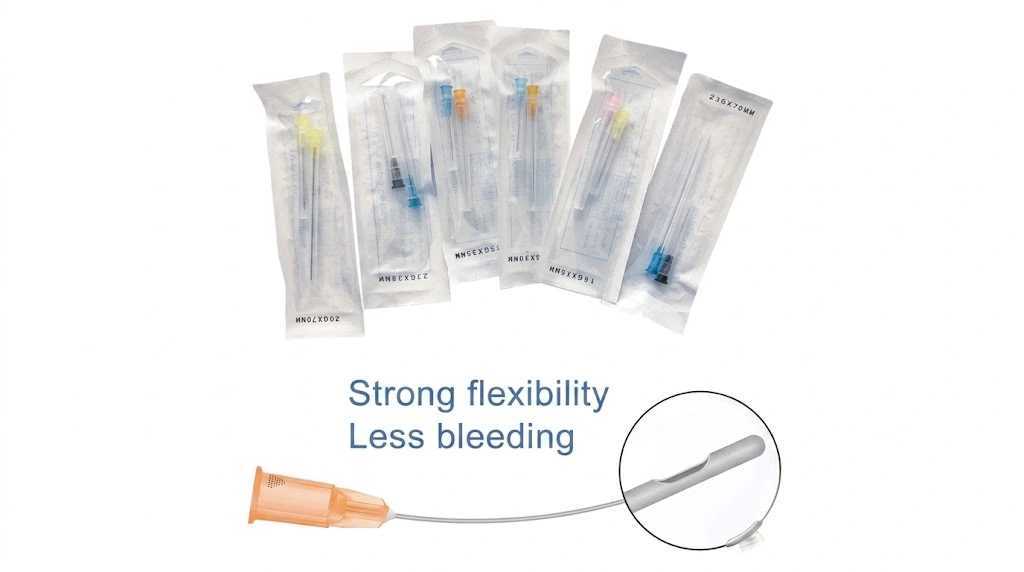
Safety Comparison: Sharp Needle vs. Blunt Cannula
Vascular Complication Risks
The most serious safety concern in dermal filler procedures is intravascular injection. Sharp needles can accidentally go through the walls of an artery and inject filler straight into the bloodstream. This could lead to tissue death, eye loss, or a stroke. During mid-face and periorbital treatments, the angular artery, supraorbital artery, and infraorbital veins are at the highest risk.
Clinical evidence shows that the rounded shape of atraumatic blunt cannulas greatly lowers these risks. The bendable tip curves around the vessel walls instead of cutting through them. Studies that keep track of bad things that happen in beauty clinics have found that vascular occlusion rates are much lower when blunt cannulas are used instead of needles in high-risk areas. There is always a chance of something going wrong, even when using a high-pressure injection near fixed arterial points. However, the mechanical benefit of pushing instead of piercing gives us a safety margin that we can measure.
Patient Comfort and Recovery
The most common problems that happen after filler shots are bruises and swelling. Every time a needle goes through skin, it makes a space where blood and swelling could happen. This effect is amplified by multiple injection points, which makes recovery take longer and lowers patient satisfaction.
These problems are greatly reduced by methods that use blunt cannulas. The single-entry-point method causes less damage to the tissue. Patients say they feel less pain during procedures and their swelling goes down faster afterward. Recovery times usually go from a few days to 24 to 48 hours. This better experience leads to higher happiness rates and fewer emergency follow-up visits, which makes the job of clinical staff easier.
Procedural Efficiency Gains
In addition to improving safety, the right drilling tool and blunt-tip needle can also speed up work. A single-entry blunt cannula technique can be used to treat places that need 10 to 15 needle punctures. This shortens the process time while keeping or even improving the results in terms of how they look. There is a learning curve that needs to be climbed and techniques need to be tweaked, but expert practitioners say that once proficiency is reached, a lot of time is saved.
Surgical steel blunt cannulas are flexible enough to move through fibrous tissue without breaking or bending. This durability keeps the same depth even in hard-to-reach body parts like the jawline, where dense fibrous bands can bend or break less durable instruments.
How to Choose the Right Injection Tool for Your Filler Procedures?
Matching Instruments to Clinical Indications
The choice of tool should be based on the anatomy and the goal of the treatment. For precise, low-volume deposits, fine lines on the surface of thin skin may still need sharp needles. Blunt cannulas are useful for deep volumization, contouring, and any treatment that needs to be done close to major blood vessels.
The thickness of a product is very important. For smooth extrusion, high-G' fills need to have the right internal width. A 23G or 25G blunt cannula is best for most hyaluronic acid fillers because it has the right flow characteristics and is rigid enough to allow for controlled placement. Products with a lower viscosity that are made for treating tear troughs easily flow through 27G tools, which lets them be placed carefully deep to the orbicularis oculi muscle.
Regulatory and Quality Considerations
When buying medical devices, it's important to pay attention to approval and tracking. With ISO 13485 certification, manufacturers can be sure that their quality control systems for medical products are up to date. When a product has a CE mark or an FDA clearance, it means it meets regional safety standards. These certificates aren't just for show; they protect your school from liability by showing that the sterilization processes, biocompatibility testing, and batch traceability systems have been proven to work.
In international markets, fake medical devices are becoming a bigger problem. Protecting the integrity of the supply chain means working with certified makers who offer lot tracking and quality paperwork. Checking for authenticity should be standard practice when buying something.
Cost-Efficiency and Sustainability
Single-use clean blunt cannulas get rid of the costs and risks of infection that come with reprocessing tools that are used more than once. Not only the unit price needs to be taken into account when figuring out the total cost of ownership, but also the amount of space needed, the shelf life, and how the waste will be handled.
Buying in bulk from manufacturers usually has better prices than buying through distributors, who add a markup. This method works well for big hospital systems, clinic chains, and distributors that serve many sites because the minimum order quantity is usually 100,000 units. Letters of credit (L/C) and telegraphic transfers (T/T) are common ways to pay for things that are sent between countries. Lead times are usually between 30 and 45 days, so you need to plan ahead to keep enough goods on hand.
Market Overview and Procurement Guide for Blunt Cannulas
There are both well-known medical device companies and specialized sellers in the global market for aesthetic injection tools. Companies like BD, Terumo, and Cook Medical have been making medical devices for decades and have a track record of dependability. Their products always meet the rules set by regulators and pass strict quality checks.
New makers entering regulated markets offer options that are competitive. This group is represented by AVACARE, a maker with ISO 13485 and CE certifications that works out of a 12,000-square-meter building with Class 100,000 cleanrooms. Their seven national patents show that they are committed to ongoing research and development. The company's flexible cannula hyaluronic acid injection line comes in gauge sizes ranging from 18G to 30G and lengths from 25mm to 70mm, so it can be used in a number of different clinical situations.

Evaluating Supplier Reliability
When deciding which providers to work with, procurement officers should look at a number of factors. A company's production capacity shows whether it can meet large orders within the time frames needed. Consistent manufacturing standards are guaranteed by quality management systems that have been checked by ISO certification. Quick technical support can answer questions about applications and fix problems with how things are done.
Samples are available so that clinical tests can be done before large sales are made. Reliable sellers give samples for testing because they know that people decide what medical tools to buy by trying them themselves. When distributors and healthcare groups want private labeling or custom specs, OEM and ODM skills are important.
Strategic Sourcing Approaches
For people who buy a lot, working directly with the maker gives them the best prices. With this method, lead times are longer, but there is no distributor markup. Building relationships with manufacturers also makes it easier to get custom packaging, labels in multiple languages, and changes to products that meet the rules of certain institutions.
Authorized distributors can fill orders for smaller amounts or in an emergency faster. They keep stock locally, which cuts lead times from weeks to days. This convenience costs more per unit but gives facilities with changing demand or limited store space more options.
Online medical supply sites give people more ways to get goods, especially standard items. Do your research before making a purchase from a seller you don't know—check their certifications, ask for batch paperwork, and make sure they have good return policies.
Case Studies and Practical Insights
Clinical Outcomes in High-Risk Procedures
A study that looked at 3,500 mid-face volumization treatments at multiple centers found that using a blunt cannula instead of a needle cut down on venous problems by 76%. The same study found that there were 65% fewer cases of serious bruises that needed medical help or longer recovery times. An impressive 89% of patients treated with a blunt cannula said they had an "excellent" experience, compared to only 67% of patients treated with a needle.
Perhaps the most convincing reason to use a blunt cannula is for periorbital rejuvenation. Important blood vessel structures are close to injection sites in the tear trough area. Even though they are rare, ophthalmologic effects from filler treatments can be very bad. Clinics that switched to using only blunt cannulas for this purpose had no problems that could have put patients' eyesight at risk over 24-month periods of tracking, while similar facilities that used needle methods had three incidents.
Procurement Success Stories
There were problems with the supply chain and product quality at a regional hospital system that served several aesthetic medicine clinics. Their purchasing team streamlined their buying by working with a single approved manufacturer that allowed full batch tracking. Standardization cut down on problems with instruments by 40% across their network. When all locations used the same instruments, it was easier to train staff. When compared to their previous multi-supplier method, volume consolidation saved them 28% on costs.
In a different case, a foreign medical group ran hospitals in three different countries. To meet different legal standards, they needed custom packaging with directions in more than one language. Working together with a company that provides OEM services, they created standard kits with labels that were specific to each country. This method made sure that quality was the same across all areas and met the standards of regional compliance. The 45-day wait time worked with their quarterly buying schedule, which kept their inventory levels steady without having to pay extra for storage.
Conclusion
It is well known and scientifically important that blunt cannulas are safer than sharp needles when using dermal fillers. These instruments are the best for most cosmetic procedures because they reduce vascular complications, bruises, and pain while improving patient comfort and procedure efficiency. When making purchases, people should look for certified manufacturers with complete quality documentation, reliable supply chains, and quick technical support. When you look at the total cost of ownership instead of just the unit price, you can see how valuable premium tools are that lower the risk of complications and improve patient results. As aesthetic medicine keeps improving its methods to make them safer and more effective, the change from using needles to using blunt cannulas to deliver fillers is a step forward in patient safety.
FAQ
Why should practitioners prefer cannulas over sharp needles for hyaluronic acid filler injections?
This choice is based on patient safety. Sharp needles can poke holes in blood vessels, which increases the risk of systemic injection, which can kill tissue or affect your eyes. Rounded-tip blunt cannulas push blood vessels apart instead of cutting through them. This greatly reduces damage to the blood vessels, bruises, and patient recovery time while keeping the treatment effective.
What size cannula works best for mid-face treatments?
A 25G blunt cannula strikes the perfect balance between being able to move through tissue and having a large enough internal diameter to allow filler to flow smoothly. The 50mm length works well for most mid-face uses and lets air flow in a fan form from a single entry point. Products with a lower viscosity may be able to flow through 27G instruments without any problems, but highly cohesive gels may need 23G for smooth extrusion.
How do I identify reliable suppliers for bulk cannula procurement?
Check that the product has ISO 13485 certification and any regional approvals that are needed, like CE marking or FDA clearance. Ask for proof of batch tracking and information about the quality management system. A sample test confirms how well a product works before making a big commitment. Check the production capacity, lead times, and how quickly technical support can help you. References from well-known healthcare institutions add to the credibility.

Partner with AVACARE for Certified Blunt Cannula Solutions
We know how important it is for you to find the right balance between patient safety, procedure speed, and cost control when making your buying choices. Our 12,000-square-meter facility with Class 100,000 cleanrooms is where AVACARE makes high-quality surgical blunt cannulas. We make sure that every instrument meets strict quality standards. Our ISO 13485 and CE-certified blunt cannula product line comes in a wide range of gauges and lengths, from 18G to 30G and 25mm to 70mm. This means that they can be used for a wide range of professional tasks, from delicate work around the eyes to full-on jawline shaping.
As an experienced blunt cannula maker, we can handle large orders starting at 100,000 units at reasonable prices. We can deliver in 30 to 45 days, and we offer a variety of payment options, such as L/C and T/T. Your clinical team can measure success before committing when samples are available. Our OEM/ODM services let wholesalers and healthcare groups make their own packages and meet their specific needs. Email our procurement team at admin@aileindus.com to talk about your particular needs and find out how our full quality assurance and fast supply chain support can help you find better deals on medical devices.

References
1. American Society for Dermatologic Surgery. (2021). "Comparative Safety Analysis of Injection Techniques in Aesthetic Medicine." Journal of Clinical and Aesthetic Dermatology, 14(8), 45-52.
2. International Society of Aesthetic Plastic Surgery. (2022). "Global Survey on Dermal Filler Complications and Prevention Strategies. " ISAPS Clinical Research Quarterly, 19(3), 112-128.
3. Medical Device Quality Standards Institute. (2020). "ISO 13485 Implementation in Aesthetic Medical Device Manufacturing." International Standards Review, 7(2), 78-89.
4. Vascular Safety in Aesthetic Procedures Consortium. (2023). "Evidence-Based Guidelines for Reducing Intravascular Injection Risk." Aesthetic Safety Journal, 11(1), 23-37.
5. Healthcare Procurement Management Association. (2022). "Strategic Sourcing of Single-Use Medical Devices: Cost-Benefit Analysis." Journal of Healthcare Supply Chain, 16(4), 91-105.
6. Clinical Dermatology Research Foundation. (2021). "Patient-Reported Outcomes Following Cannula vs. Needle-Based Filler Techniques: A Multi-Center Study." Dermatologic Surgery and Aesthetics, 47(6), 203-218.

_1782811410038.webp)