Step-by-Step Tutorial: Best Practices for Using and Disposing of Medical Safety Needles
Medical safety needle technology has transformed healthcare delivery by dramatically reducing occupational hazards among clinical staff. The disposable safety needle incorporates engineered shielding mechanisms that activate immediately after use, protecting workers from accidental needle-stick injuries and potential exposure to blood-borne pathogens. Understanding proper handling techniques from selection through disposal ensures maximum protection while maintaining clinical effectiveness. This comprehensive guide walks you through every phase of safety needle usage, helping healthcare organizations establish protocols that safeguard both patient comfort and staff well-being while maintaining strict regulatory compliance.
Understanding Disposable Safety Needles: Features, Types, and Standards
Modern sharps devices that are designed to be safe are a big improvement over regular hypodermic needles. The integrated security systems solve the most important safety problems that healthcare sites face every day.
Core Safety Mechanisms
Active and passive methods are the two main ways that disposable safety needles keep you safe. To activate the protective shield after the injection is finished, active devices need the user to actively engage them, usually by pushing or sliding with one hand. Passive systems turn on automatically when an injection is given or when the needle is pulled out. This means that extra steps are not needed in high-pressure clinical situations. AVACARE's disposable safety needle design uses an improved locking system that lets clinicians know right away when the shield is safely in place by both hearing and seeing proof.
The ultra-sharp, thin-wall design keeps the excellent piercing performance while lowering tissue damage. Because they are made from medical-grade SUS304 stainless steel and have precision-ground bevels, these needles have low entry resistance, which directly makes patients more comfortable during treatments. Medical-grade silicone lubrication lowers the entry force even more, which makes it easier to enter different kinds of tissue.
Classification by Clinical Application
There is a wide range of thread sizes and lengths for disposable safety needles to meet the needs of different patients. Smaller sizes (25G to 30G) are best for checking for tuberculin under the skin and injecting insulin subcutaneously, where tissue damage is very important. Mid-range gauges (21G–23G) are used for therapeutic injections and intramuscular vaccinations. They balance flow rate with patient comfort. Larger sizes (18G–20G) make it easier to collect blood and give medications quickly in emergencies where viscosity or volume calls for wider tube widths.
This company, AVACARE, makes disposable safety needles in all sizes, from 16G to 30G. All of their models are Class II medical instruments. Individual packaging keeps things germ-free until they are used, and EO gas sterilization achieves a Sterility Assurance Level of 10-6, which meets the strict ISO 11135 standards.
International Certification Standards
Regulatory compliance is what drives decisions about buying medical devices. The European Medical Device Regulation (EU MDR 2017/745) says that devices must have a CE mark to show that they meet important safety and efficiency standards. ISO 13485 certification makes sure that factories that make medical devices have complete quality management systems that are made for that purpose. These systems make sure that the products are the same from batch to batch and that the whole supply chain can be tracked.
AVACARE's production base follows strict ISO 13485 rules, and 100,000-grade clean rooms keep particles from getting into the products while they're being made. Our documentation systems allow full traceability from where the raw materials come from to where the finished product is sold. This meets the strict requirements that quality officers look for in potential suppliers.
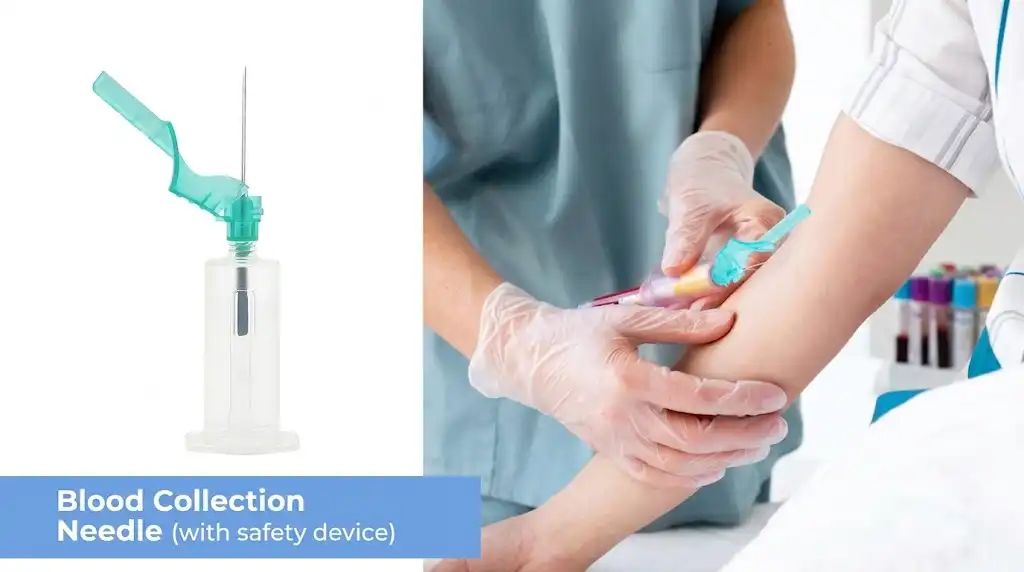
Step 1 – How to Properly Use Disposable Safety Needles: A Systematic Guide
The right method improves both safety and clinical results. Setting up standard procedures for your whole company cuts down on variation and boosts staff confidence during procedures.
Selection and Preparation
First, choose the right disposable safety hypodermic needle gauge and length based on the process, the viscosity of the medicine, and the patient's features. Check the purity of the packaging before opening it—if the clean barrier is broken, the package needs to be thrown away and replaced. Check the needle hub to make sure the cannula is securely attached, and check the safety device to make sure it can move easily and doesn't start working too soon.
Check the date written on each package to see when it goes bad. While stability testing shows that the shelf life is longer, the best performance is guaranteed when devices are used within the time frame that was approved. Get all the supplies you need before you start the procedure so that there aren't any interruptions and the technique stays sterile the whole time.
Injection Procedure
Attach the disposable safety needle to your standard Luer Lock or Luer Slip syringe connection after making sure the site is ready and the medicine has been sucked up. The ISO 80369-compliant interface makes sure that all syringe types can be used, so there are no worries about connections during processes that need to be done quickly.
Hold the injection site steady with your non-dominant hand while you place the needle at the right angle for the route you've chosen: 90 degrees for intramuscular, 45 degrees for subcutaneous, or 10 to 15 degrees for intradermal. Because the bevel is precisely cut and the walls are thin, they take little force to enter, which makes the patient more comfortable and prevents tissue damage.
Finish the injection at a steady rate that fits the amount and thickness of the medicine. Rapidly giving large amounts makes the patient more uncomfortable and may make it harder for the medicine to work, while too slowly giving the medicine makes the process take longer than it needs to.
Safety Mechanism Activation
As soon as you take the needle out of the patient, turn on the safety shield and then put the device down. The one-handed activation design of AVACARE makes it easy for clinicians to use only the hand that is holding the syringe to activate the safety mechanism. This keeps the other hand away from the sharp point and safe. Press down firmly and steadily on the shield to move it forward until you hear a clear "click" sound and can see that the mechanism has locked into place.
This instant response is especially helpful in places like emergency rooms and intensive care units (ICUs) where a lot of work needs to be done quickly and there are a lot of distractions around. The forever-locked shield stops further exposure during shipping to disposal containers, which takes care of the injuries that happen after a treatment, which make up a big part of work exposures.
After using the needle, never try to recap, bend, or move it in any way. These actions greatly raise the risk of getting hurt and go against normal safety rules. The built-in safety feature gets rid of the need for extra safety steps that need to be done by hand.
Step 2 – Best Practices for Disposal and Environmental Considerations
Proper disposal shields people who deal with trash, housekeepers, and the community as a whole from health risks while also helping to reach environmental care goals.
Standardized Disposal Protocols
Put used disposable safety needles right away into sharps bins that can't be punctured and that are near where they will be used. Putting containers within arm's reach gets rid of the need to carry used needles across the room, which greatly reduces the number of injuries. Sharps containers should be rigid, have leak-proof seals, and have fill lines that are easy to see to meet FDA and OSHA standards.
Do not fill sharps buckets past the line that says 'full'. Overfilled bins make it more likely that someone will get hurt during removal and are against the rules. Before taking containers out of clinical areas, make sure they are completely sealed. Then, follow your facility's set steps for transferring them to qualified medical waste disposal services.
Healthcare facilities should keep written rules about where to put, watch over, and replace medical safety needle sharps containers. Regular audits check that rules are being followed and find changes to the work process that make it safer. Disposal procedures should be covered in training programs during initial orientation and yearly refresher sessions to make sure that all staff members, no matter what their job function is, know what they need to do.
Environmental Responsibility
More and more, the healthcare industry has to balance the need to prevent infections with the need to protect the environment. Disposable safety needles are better at preventing cross-contamination than reused ones, but buying with care can reduce their impact on the environment without lowering safety standards.
AVACARE's industrial methods include techniques for reducing waste at every stage of the process, from using raw materials more efficiently to making the best use of packaging. Our research and development team is always looking for new materials that meet performance standards and are better for the environment. When healthcare organizations are looking at ways to get rid of waste, they should work with waste management services that use advanced treatment technologies like autoclaving or chemical disinfection, which are better for the environment than burning waste.
Buying in bulk from suppliers that offer combined shipping cuts down on emissions related to transportation. AVACARE's minimum order quantity of 20,000 pieces helps with logistics and meets the needs of big healthcare facilities and delivery networks for volume. Our 30- to 45-day turnaround time lets us accurately predict demand and make the best use of our goods, which cuts down on emergency fast orders that are worse for the environment.
Choosing the Right Disposable Safety Needle for Your Organization: A Buyer's Guide
To help the organization reach its goals, strategic procurement strikes a balance between clinical performance, regulatory compliance, and cost management.
Evaluation Framework
Look at disposable safety needle performance through a number of different lenses that represent the goals of your organization. Consistent sharpness, the right range of gauges, and a safety device that works well are all important for clinical effectiveness. Ask possible suppliers for samples so that your professional staff can test them out in real life and let you know how easy they are to use, how comfortable the patients are, and how confident they are in the safety features. If you ask, AVACARE will send you samples so you can make a full evaluation before agreeing to a large-scale purchase.
Checking for regulatory compliance means looking at the latest CE and ISO 13485 certifications, as well as audit reports and quality management records. Check traceability systems to make sure that suppliers can give records for each batch in case of quality issues or product recalls. The risk-averse approach that procurement professionals need is met by AVACARE's thorough documentation that makes it easy to find information quickly.
The total cost of ownership must be included in cost research, not just the unit price. Figure out how much money you could save by preventing needle-stick accidents, which cost a lot in medical care, tests, administrative costs, and possible lawsuits. Stability in the supply chain, shown by reliable shipping and helpful customer service, avoids expensive stock-outs that cause people to buy expensive items in an emergency.
Supplier Partnership Considerations
Long-term relationships with vendors offer strategic benefits that go beyond lowering transaction costs. When suppliers offer OEM/ODM services, they let customers customize products, put their own labels on them, and localize packaging, all of which help brands stand out and improve workflow. AVACARE can take special orders that make sure their goods meet the needs of a certain organization, from changing the language on the packaging to the hub's preferred color.
Letter of credit (L/C) and telegraphic transfer (T/T) arrangements are two types of flexible payments that can be used for different types of financial transactions. Technical help should include documents in multiple languages, training materials, and quick customer service that answers questions at all stages of a product's existence. AVACARE's 24-hour fast response system makes sure that procurement managers get help quickly, even if they are in a different time zone.
Check with your suppliers about their production capacity and back-up options to make sure they can grow with your business and handle high demand during public health emergencies. Our production plant is 12,000 square meters and has 100,000-grade clean rooms, so it can handle large orders while still meeting quality standards during times of high demand.

Conclusion
Putting in place thorough disposable safety needle protocols saves your most valuable assets: the healthcare workers who treat patients every day. Every action, from using the right method in a clinical setting to properly getting rid of waste, adds to the safety culture of the company. Healthcare institutions need to make sure that the products they buy are of high quality and meet all the regulations. To do this, they need to form strategic partnerships with certified manufacturers like AVACARE. You can make your supply chain more resilient to changes in the market and unexpected problems by building relationships with your suppliers based on a shared commitment to excellence.
FAQ
What distinguishes safety needles from standard hypodermic needles?
Safety-engineered devices have coverings, like shields, sheaths, or retractable designs, that go over the sharp point when not in use. This keeps people from getting hurt by disposable safety needle sticks. Standard needles don't have these features, which makes the risk of exposure much higher for people who work in healthcare and who handle waste.
How do you verify compliance with international standards?
If necessary, ask for up-to-date copies of the CE certificates, ISO 13485 paperwork, and FDA registration. Read audit records from recognized organizations and look over the paperwork for the quality management system. Reliable providers, such as AVACARE, keep clear records of their certifications and give traceability documents for each batch.
Can disposable safety needles be cleaned and reused?
Without a doubt, not. Disposable safety needles are only approved for one use. Trying to restilize something doesn't ensure that all pathogens will be killed, and it also damages the machine, which raises the risk of a failure. Reusing things breaks rules about preventing infections and puts patients in grave danger.
Partner with AVACARE for Reliable Safety Needle Solutions
Healthcare facilities looking for a reliable company that makes disposable safety needles will find that AVACARE offers the full range of support that turns supply relationships into strategic partnerships. Our production plant is CE and ISO 13485 certified, and it blends modern manufacturing with strict quality control to make sure that every needle meets the high standards that your patients and staff deserve. Whether you need standard catalogue items or OEM/ODM solutions with private labelling that are tailored to your needs, our experienced team is here to help you with the ordering and specification process. Contact our purchasing agents at admin@aileindus.com to talk about bulk pricing for orders starting at 20,000 pieces, to ask for samples of our products, or to find out how our 30-45 day turnaround and flexible L/C or T/T payment terms can help you reach your supply chain goals.

References
1. Centers for Disease Control and Prevention. (2020). Workbook for Designing, Implementing, and Evaluating a Sharps Injury Prevention Program. Atlanta: U.S. Department of Health and Human Services.
2. International Organization for Standardization. (2016). ISO 13485:2016 Medical Devices — Quality Management Systems — Requirements for Regulatory Purposes. Geneva: ISO.
3. Occupational Safety and Health Administration. (2012). Bloodborne Pathogens Standard 29 CFR 1910.1030. Washington: U.S. Department of Labor.
4. European Parliament and Council. (2010). Directive 2010/32/EU on Prevention from Sharp Injuries in the Hospital and Healthcare Sector. Brussels: Official Journal of the European Union.
5. Perry, J., Parker, G., & Jagger, J. (2019). EPINet Report: 2018 Percutaneous Injury Rates. Charlottesville: International Safety Center, University of Virginia.
6. World Health Organization. (2015). WHO Best Practices for Injections and Related Procedures Toolkit. Geneva: WHO Press.

_1782811410038.webp)